Investigate G-d for Only 2 Weeks: A Challenge Worth Taking


In this premiere episode of Season 2 of The Torah Broker Podcast, Rabbi Dovid Bernstein joins Torah Broker Sanford Burstyn for a thought-provoking discussion on the existence of G-d, the truth of the Torah, and the search for life's purpose. Through engaging stories, practical examples from nature, and timeless Torah wisdom, Rabbi Bernstein challenges listeners to examine the evidence for G-d with an open mind.
The conversation explores how the natural world points to a Creator, why the Torah's remarkable preservation is unique in history, and why taking the time to honestly investigate these questions may be the most important investment a person can make.
Subscribe for more episodes ➤ / @torahbroker
Rabbi Dovid Bernstein, originally from Milwaukee, Wisconsin, has dedicated decades to Jewish education as an educator, consultant, and speaker. During his many years with Torah Umesorah, he directed the Aish Dos teacher training program and Chevras Yesud Ma’aloh, the Principals Fellowship, while serving as an educational and rabbinic consultant to Jewish schools around the world. Known for his practical understanding of human nature and his ability to apply timeless Torah principles to contemporary life, Rabbi Bernstein currently resides in Jackson, New Jersey.
The Torah Broker Episode 8
Investigating G-d for Only 2 Weeks
[00:00] Rabbi Bernstein
What have you got to lose? The worst that would happen is you're going to go through the two weeks and you decide, but you're not convinced it's not true, and you'll go back to whatever you're doing. But if that's true and there's something called the World to Come and eternal life after this world, I mean, that's a pretty big prize.
[00:21] Rabbi Bernstein
You're a businessman. Would you not think that's worth an investment of two weeks to investigate?
[00:42] Sanford
Welcome to Episode Eight of The Torah Broker. This is the premiere episode of Season Two. Today we have from New Jersey Rabbi Bernstein, the famous overseer of education in the Jewish school system throughout America, probably for about 40 years. You'll see that the rabbi looks much younger than that. But he's been at it for those decades. Originally, the rabbi was a prodigy at the age of 21, teaching musical score analytics at Yale University.
[01:15] Sanford
You can imagine what that school was back then. The rabbi then made a switch, went to Jerusalem, went into yeshiva. Since then, the rabbi has been very focused on assisting with all the various aspects of Torah school administration, teaching sensible curricula for the various institutions and grade levels, etc. Today we're going to talk about a number of different things. I think as the rabbi and I were speaking earlier, I think maybe we should open up with God.
[01:56] Sanford
Why don't I turn it over to Rabbi Bernstein?
[02:00] Rabbi Bernstein
So, Sanford, this is a real treat to be here. And I'm honored by this. And I appreciate the opening question that you just threw at me. It's interesting. We live in a society, even among Jews, that we rarely talk about God.
[02:28] Rabbi Bernstein
If God is the creator of the universe and he's the one who's the author of the Five Books of Moses and of the Bible, so that's an issue that needs to be addressed. You know, I remember growing up, I went to public schools. Almost never heard about God. I once had a principal, a non-Jewish principal, who asked children in the room, "Do you believe in God?" I think that was the only time I ever heard somebody ask that question. You know, I went to Hebrew school. It just—it's not something that we typically talk about. So I got a little story for you.
[03:18] Rabbi Bernstein
I like to travel to Israel once a year or so, and I go to the Western Wall, and I pray there, and I visit family and other things I do. So a few years ago, I was on an El Al flight. I usually come with my books, my story that I'm studying, and I have a practice—I don't usually start up conversations with people next to me until we're pretty well into the flight. I've got done what I've got done, and then I do speak to the people around me.
[03:43] Rabbi Bernstein
So on this particular flight, there was a young man. He was a kollel student. That means he studies Torah full-time. He's an Israeli. In the middle of the flight, he says to me in English, "Are you aware that we have a program, a computer program here that lets you know when is sunset in the middle of the ocean as we're flying and when it's sunrise, and when is the proper time to say this prayer and that prayer?" I said, "I don't know anything about that."
[04:28] Rabbi Bernstein
And he introduces it to me. I said, "How do you know about that?" And he says, "Well, really, I have a story." And what was his story? His story was that he was a secular Israeli. He'd been in the army, didn't know anything about religion, and he wanted to go do some business. So he found some small Asian country somewhere, and he set up an office there, and he was busy buying and selling and so forth in his blue jeans with his long hair.
[05:06] Rabbi Bernstein
And one day he flew into the country from Israel. He was now living over there, and somehow he lost his wallet and his passport. What happened? I don't know, but he couldn't get around. He didn't have the money to get a taxi cab to take him to the hotel, and he couldn't check into the hotel because he didn't have his identification papers.
[05:32] Rabbi Bernstein
And it was a Sunday. So they had one building in the middle of town which had all of the Jewish facilities there. There was the Israeli consulate. There was the one synagogue in town. There was a kosher restaurant. I don't know, whatever the federation, whatever they had there. So he made his way over there on foot in order to get to the Israeli consulate.
[05:58] Rabbi Bernstein
But it was closed. So I know what to do. And as he's standing there, a rabbi comes over to him and says, "Can I help you?" I imagine they were speaking in Hebrew, but I don't know. And he tells them the story. He says, "Oh, don't worry about that. I'll take you downstairs. Let's get a good lunch. There's a kosher restaurant down there, and we'll work on getting your papers and a place for you to stay overnight until the consulate opens up."
[06:28] Rabbi Bernstein
So they go down and sit down at the table. And this very kindly rabbi is taking care of him, giving him lunch. And an older rabbi walks in. Who is that? That's Rabbi Ezriel Tauber. Did you ever hear of Rabbi Ezriel Tauber? Oh my goodness. So this is a treat.
[06:58] Rabbi Bernstein
Rabbi Tauber was a Holocaust survivor and became a very successful businessman, and became an author and a major lecturer on Judaism.
[07:24] Rabbi Bernstein
And at this stage of his life he had become elderly, and he wanted to use every day that he had. So he decided he's making a whirlwind tour of college campuses in different countries, and he's going to speak to young people about the hidden codes in the Torah. Are you aware of the hidden codes in the Torah?
[07:24] Rabbi Bernstein
So that's a subject. There are every so many letters, if you count, you can find all kinds of secret messages. So he was—he's into that. He liked that. And one of his stops was this little obscure Asian country. And he was giving a three-night program, and he just finished two nights and he was there for lunch.
[07:50] Rabbi Bernstein
So the rabbi invited him to sit down, and they sat down and they all ate. And then he gets up and leaves, and the rabbi says to our friend—he says to him, "Do you know who that was? That's Rabbi Tauber. And you know, you're stuck here anyway. You can't do anything until tomorrow. Might as well go to his presentations and you might find it interesting."
[08:13] Rabbi Bernstein
So the young man attends that night and he is spellbound. His subject was about God, like he also had never heard anybody discuss it. And Rabbi Tauber did it with his masterful insights. At the end he comes over and he says, "Can I have a word with you?" He says, "Sure." He says, "I've never heard anything like what you just presented to me."
[08:40] Rabbi Bernstein
"Never heard anything like it in my life. What do I do now?" So Rabbi Tauber said on the spot, he said, "I can't invite you to study with me because I'm on a whirlwind tour. Whirlwind tour, and I'm heading back to New York. But if I were you, I would take two weeks and just investigate. Is what I told you true?"
[09:08] Rabbi Bernstein
"Is there in fact a God who runs the world? And is that God the author of the Torah? Because look, if that's true and there's something called the World to Come, an eternal life after this world, I mean, that's a pretty big prize. You're a businessman. Would you not think that's worth an investment of two weeks to investigate?"
[09:40] Rabbi Bernstein
The young man thought about it. He said, "You know, I think that it makes a lot of sense." So Rabbi Tauber wished him well. You know, he said, "What have you got to lose? The worst that would happen is you're going to go through the two weeks and you decide that you're not convinced it's not true, and you'll go back to whatever you're doing."
[09:57] Rabbi Bernstein
"But for two weeks, it could be you're going to end up with a happy life and eternal life also. I mean, that's a big prize. It's worth two weeks looking into it." And now this is 20 years later. Young man is sitting next to me on the airplane. He's got a wife, he's got six happy children. He's got a purpose.
[10:25] Rabbi Bernstein
He knows enough to explain to me about this complicated computer program. Because in the place where he studies Torah, the author of the program is sitting there with him. So that is my little story to you about investigating whether there's a God or not.
[10:49] Sanford
Rabbi.
[10:53] Sanford
I've only had, I think, one similar meaningful conversation on an airplane like that. Can I share it, please? I don't know where I was flying from or to.
[11:10] Sanford
There's a seat between us. And this man is a military man, and he makes a very strong optical impact with all of the different colors and metals and stuff. It turns out he worked in the library at the West Point area of battles, storied battles. They have recorded history of battles from the Greeks and the Romans, with catapults and bows and arrows and rocks, and the most primitive forms of equipment and combat.
[11:59] Sanford
He sees I'm Jewish with my head covered, and for some reason I thought he would weave in something about Jewish and Israeli battles, which he didn't. So I introduced it, and he said, "They don't. They don't really look to us." I didn't really understand what that meant. "Would you understand what that means? We don't look at those." So I said to him, "What does that mean?"
[12:24] Sanford
And he said, "We can't explain them." It got me thinking, obviously, and I think we see that with Israel made up of—
[12:37] Sanford
What, seven, eight million Jews with a military presence superior to countries in Europe, with 50 to 80 million people per country, the United States with 360 million people. Iran's got over 90 million people. But this is, I don't think, necessarily a demonstration of Jewish technology or capability. And it gets more—the fact that God empowers us to demonstrate our mission of serving Him.
[25:42] Rabbi Bernstein
That's exactly, that's exactly the point. So it's a, you know, the theory of evolution is still out there. They're still teaching it in university, even though now hundreds of years ago. And by—and I'm not the only one to ask these questions and there are no answers about it. I once heard about a book where a mathematician—
[26:06] Rabbi Bernstein
Excuse me, you know, calculated how many generations of mutations would you need to change one species into another? And he proves that there aren't enough years in the history that they claim—the billions of years of the world existed—to make it happen. You know, it gives you one last objection to the theory of evolution. And that is there's never been one documentation of a species mutating into another species.
[26:41] Rabbi Bernstein
We have lots of documentations of mutations. And this plant changed its color or this moth changed its color. Yeah, we have that, but never a moth changing in such a way that it needs to reproduce differently. And it has another kind of a mate. There's never been a change of species. Never once has there been, even with tiny little cell-like creatures, they've never been able to document that there's a change of one species to another.
[27:14] Rabbi Bernstein
Each species just keeps going. And if it stops going, then it becomes extinct. It doesn't mutate and make a new species. They've never found one. And the whole theory of evolution is that species mutate in a way that the monkey eventually becomes a man, and we're not anywhere. There would be so many billions of different levels between the monkey and the human being that, you know, show me where those skeletons are.
[27:43] Rabbi Bernstein
So occasionally they claim, oh, they dug something up. And this is in between a monkey and a man. Okay, that's me in a monkey and a man. Where are the millions of others necessary to get from this one to this one, to this? To that one? They've never been able to show that.
[27:58] Sanford
I can't think personally—I speak personally—of a more empty, inconsequential subject to look at or study than anything else I could imagine. You know, I, I, I like to think about—
[28:17] Sanford
Giving every perspective, the benefit of the doubt. So when I came to this, I thought like this. First of all, you look at everything here. You look at everything on the planet for crying a lot. And nothing is without a maker. So try to think about something as benign and simple as you could imagine. How about a box of toothpicks?
[28:43] Sanford
Show me a blast! That can create the consistency of size, dimension. The precision of 50 toothpicks. Don't put it in a box, just put it in the ground. Put it on a lot with your blast. It's just not doable. If you don't believe in God, just introduce it that you don't need to make a lot of academic noise to demonstrate a theory or some philosophy that really doesn't make any sense.
[29:17] Rabbi Bernstein
I'm going to give you one other argument. There's not one. There's many. I'm going to give you one, though. If you're out there looking to see, is it possible that there really is a God and that we were misled? 20th century scientific theory just kind of deviated from truth. So consider the limbs on a human being. Is it interesting that everyone has a purpose and they're designed according to their purpose?
[29:55] Rabbi Bernstein
I have an ear on both sides of my head so that I can hear from both sides. I need two eyes so that they can focus and measure distance.
[30:09] Rabbi Bernstein
Somehow my mouth is able to both eat and allow for breathing to take place and for speech.
[30:22] Rabbi Bernstein
There is no creature except the human being that can speak and the ear can listen and language can be communicated. How in the world do you say something to me? And I hear what you're saying, and I understand it. How the world that happen. It's only because every part of my mind and my, my, the limbs are all serving purposes.
[30:48] Rabbi Bernstein
In order for something to have a purpose, it has to be someone who gives it its purpose and designs it according to the purpose. Even the ridges in the ear are designed in order to catch the sounds and focus them on the three tiny bones inside the ear that vibrate and turn the sound into little electric signals that my brain can read.
[31:14] Sanford
That happened.
[31:15] Rabbi Bernstein
There's no accident.
[31:16] Sanford
That could convince anybody with any sensibility. Connect the dots and believe that, you know—you were talking about the eyes and ears, etc. My father was in the livestock business. We had farms, and I remember learning about the difference between eyes that are side by side and eyes that are on the side of the head and the side of the head.
[31:46] Sanford
There's maybe more of a vision to defend against predators, perhaps, but the eyes side by side allow you to determine depth. I know that.
[32:04] Rabbi Bernstein
I'm interrupting here for a second. Darwin, who came up with the theory of evolution himself, wrote, "My theory works, I believe, until you get to the eye." The eye is so sophisticated in its ability to absorb new information and process it that I cannot explain it according to evolution. And that's the father of evolution said that. He said, "I give up" comes to the eye.
[32:37] Rabbi Bernstein
I can't explain it.
[32:39] Sanford
That's a big man that can almost single-handedly discredit most of his career work.
[32:48] Rabbi Bernstein
And nobody paid attention to that paragraph, right?
[32:53] Sanford
Yeah. You know, Rabbi, this conversation really reminds me of the chariots, you know, where if you were to examine the body beneath the skin in detail and you were to see all of the openings between the veins and the arteries and the urinary tract and the digestive system and the lungs, they got—I imagine there's quite a few.
[33:23] Sanford
So the Jews have a custom or a law, commandment, to acknowledge and thank the Creator that all of those passageways are open. So we're not in the hospital. We don't lose blood flow to some part of our body, or we can't breathe or we can't hear. We can't eat those sorts of things. And it's after we discharge ourselves, we say the blessing.
[33:57] Sanford
Thank you, God, for providing these openings and that they're all functioning.
[34:02] Rabbi Bernstein
It's not a commandment, it's an acknowledgment. And it's about the tubes that have openings and closures. And what we're saying is we acknowledge every day when we, after we use the facilities, "Thank you, God, that all the things that need to be open are open, and all the things that need to be closed are closed," because if one of them were—that's supposed to be open is closed, and one of them is closed, is supposed to be open, it would be impossible for me to stand here in front of you.
[34:39] Rabbi Bernstein
Is that an idea? Wow. Is that an idea? It's not a commandment. It came from the rabbis. The rabbis said this is an acknowledgment of the miracle of being alive. If you took all of the blood vessels, just the blood vessels in a human body, one human body, and line them up, that means arteries and veins, capillaries.
[35:03] Sanford
Is that a mile long?
[35:05] Rabbi Bernstein
We're talking about 100,000 miles of tubes that are required for you to be here. And you and I have made this conversation, and one of them that's supposed to be open in your brain and in your heart is not closed, because if it was closed, we couldn't be—we couldn't be here. And one that's supposed to be closed.
[35:25] Rabbi Bernstein
You know, the heart has these valves. And let me tell you, it's very significant. Is the valve open or is it closed? And the little cardiac arteries there—highly significant in the life of a human being. And what happens—why people get heart attacks. Because one of those little little arteries gets clogged, gets blocked. So we acknowledge every day, "Thank God I'm here."
[35:55] Rabbi Bernstein
One of those is not blocked and one of them is supposed to be closed is not open.
[35:59] Sanford
So let's wrap this up. So we have—
[36:07] Sanford
Acknowledged that we're—we're going to consider that there's a God. We're going to study a while for evidence of that. So if we can assume that there was some evidence that caused one to believe there is a God and is a Jew, the third is to take action.
[36:33] Rabbi Bernstein
Well, I would—I want to go on one more step. My monitor says in his great book, The Mission of Torah, he says the first principle is to know that there's a God. It's true, we believe in it, but we believe in what we know. It's not an arbitrary thing that somebody, somewhere came up with. And therefore I take a walk outside, just look at the world.
[37:07] Rabbi Bernstein
It's—it's so stunning. It—it's the evidence that proves the fact that there's a God. Now, I have to be loyal to that fact and believe it. But then there's a second piece to investigate. And that is, is God the author of the Torah? Now, if God—if the same one that created this universe and is keeping me alive with all those arteries and those breathing tubes and so forth, then my next question do I have to investigate is, is the Torah true?
[37:44] Rabbi Bernstein
Torah claims that God is the author, the one that created the world, wrote a book. Now that's another piece that you have to come to investigate. And it's worth the two weeks to look into that, because if you get those two principles behind you, then you're on a path towards meaning and purpose in your life and guidance.
[38:11] Rabbi Bernstein
How to live a happy existence in this wonderful world.
[38:20] Sanford
I think from memory the bomb says study.
[38:28] Sanford
The contents of the ocean, study astrology, study animals, study the plants, study the body, all these things that God not only created but sustains will bring you to the same conclusion.
[38:45] Rabbi Bernstein
You gotta give me again. You meant astronomy, not astrology.
[38:49] Sanford
Astronomy. I'm thinking of pastrami.
[38:51] Rabbi Bernstein
I'm impossible guy over here. I don't know why you brought me.
[38:56] Sanford
Listen, you know it's a ref. You write about Sanford. Good catch. Rabbi, you know what's interesting about, existing as a Jew? That oftentimes the non-Jewish world does a remarkable job of—
[39:17] Sanford
Authenticating, proving—
[39:22] Sanford
Who we are. The church apparently was—
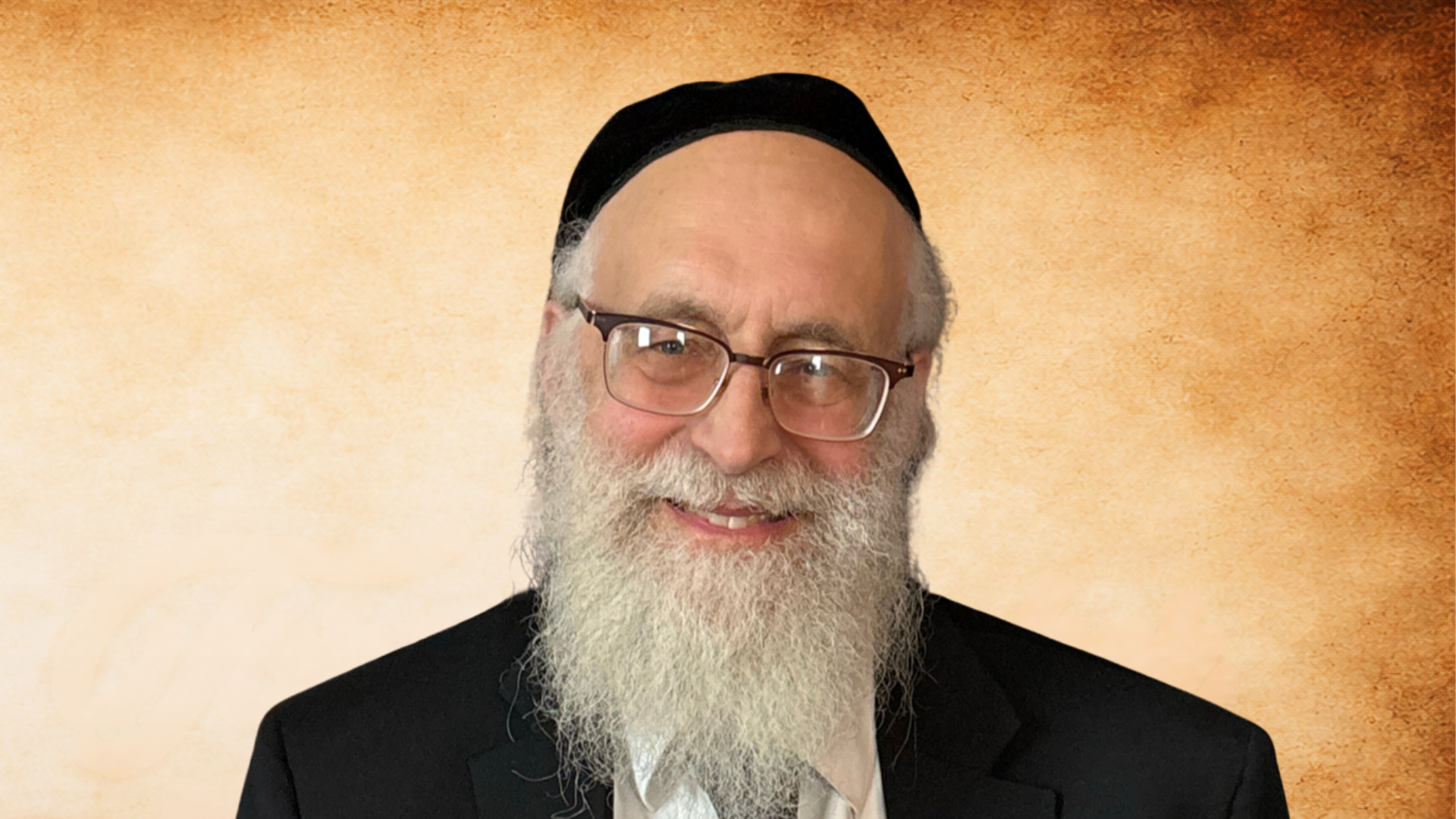
Rabbi, educator, consultant, and speaker
Rabbi Dovid Bernstein, originally from Milwaukee, Wisconsin, has dedicated decades to Jewish education as an educator, consultant, and speaker. During his many years with Torah Umesorah, he directed the Aish Dos teacher training program and Chevras Yesud Ma’aloh, the Principals Fellowship, while serving as an educational and rabbinic consultant to Jewish schools around the world. Known for his practical understanding of human nature and his ability to apply timeless Torah principles to contemporary life, Rabbi Bernstein currently resides in Jackson, New Jersey.